
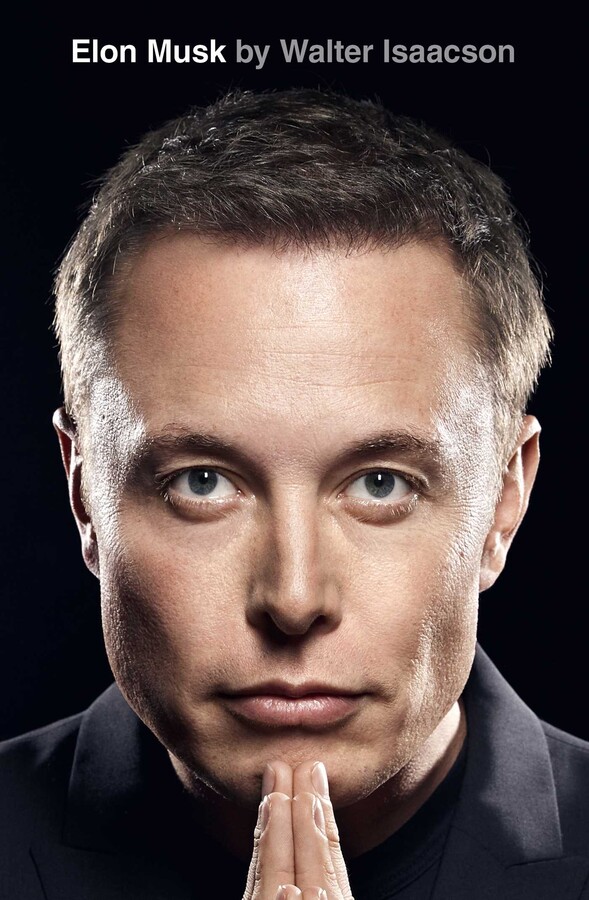
 Elon Musk
by Walter Isaacson
688 pages
Simon & Schuster
Published: Sept 2023
“Elon Musk” is Walter Isaacson’s long-anticipated biography of the mercurial entrepreneur behind SpaceX, Tesla and, most recently, the website formerly known as Twitter. Isaacson is an author, journalist and professor at Tulane University who has written popular biographies of Ben Franklin, Albert Einstein, Steve Jobs and Leonardo da Vinci.
Despite my bias against biographies of people whose lives are still unfolding, Isaacson’s biography of Elon Musk’s life proved irresistibly tempting. I was lured by my experience with two of his previous books, the prospect of gaining insight into Musk’s entrepreneurial magic and by the possibility of understanding what makes this volatile visionary tick.
But for all the potential this biography seems to offer – the world’s richest man allowed Isaacson to shadow him for more than two years – the 615-page narrative leaves me feeling deeply ambivalent. The fact this is not a “traditional” biography is not surprising. Nor is Isaacson’s attraction to a controversial figure like Musk. But the fact this biography often reads like a breezy, over-simplified exposè is decidedly disappointing.
Readers hoping to encounter a dispassionate examination of Musk’s strengths and weaknesses will be disappointed. Rather than exploring his subject’s most notorious flaws within the context of his trailblazing successes, Isaacson seems to have lost himself in the hyper-reality bubble surrounding Musk. A biographer is normally expected to be an impartial observer reporting history without leaving footprints, but Isaacson’s role here seems to have evolved into part-time friend, confidante and therapist.
While guiding the reader through Musk’s various achievements, near-misses and interpersonal schisms, Isaacson often refers back to one of his earlier biographical subjects: Steve Jobs. These comparisons, along with accounts of Musk’s relationships with Jeff Bezos, Bill Gates and other successful entrepreneurs and investors, are quite interesting. But Isaacson avoids the real work of digging deeply to determine whether Musk’s frequently callous treatment of people is a requirement for his success…or an unfortunate byproduct of his creative disruption.
And while Isaacson diligently documents much of the individual damage resulting from Musk’s impetuous behavior, he almost completely ignores alleged larger-scale issues such as an apparent disregard for highway traffic safety laws, widespread allegations of consumer fraud, a tolerance of toxic behavior on his social networking site and a disregard for laws designed to ensure financial market transparency and fairness.
Finally, Isaacson’s writing style is unusually informal and lacks an eloquent literary voice. His narrative is essentially a stitched-together collection of reminiscences, clichés and revealing fly-on-the-wall observations which seems to have been designed for fast, effortless consumption by the reader.
In spite of its flaws there is much to enjoy in this dissection of Musks’s conspicuously captivating life. Isaacson does a nice job reviewing Musk’s troubled childhood, his turbulent relationship with his father (whose own list of foibles is remarkable) and his inability to foster healthy long-term relationships. And the list of people Isaacson convinced to speak “on the record” is impressive.
Musk’s persistent desire to challenge conventional wisdom in the face of long odds and entrenched interests is a recurring theme and Isaacson never misses an opportunity to demonstrate Musk’s intuitive sense for when and where to test boundaries and spark long-needed change. This window into Musk’s relentless drive, particularly in the electric vehicle and space industries, may be the most compelling aspect of the book.
In addition, although the narrative proves far too casual and carefree for literary connoisseurs, one of its strengths is undoubtedly its accessibility. No reader will get lost in a maze of confusing engineering syntax, complex financial jargon or tedious corporate history. Isaacson clearly intended this book to provide its audience with an easy, uncluttered reading experience. One thing is certain: “Elon Musk” is never dull.
Overall, Walter Isaacson’s hot-off-the-press biography provides readers with a fast-paced, interesting and revealing look at Elon Musk – the genius and the jerk. But the book’s shortcomings are conspicuous and Isaacson’s proximity to his subject, and his willingness to rationalize or excuse Musk’s most profound flaws, limit this book’s efficacy as a biography.
Overall rating: 3 stars
 Reading the Best Biographies of All Time
Huzzah. You are back to writing and providing your excellent Biographical reviews. Looking forward to your comments on Richard Norton Smith’s book on Gerald Ford.
I like the book not so much the subject. The technology aspects of his story are very interesting. So yup Musk is a smart guy with a sick work ethic who has been smart enough to surround himself with brilliant people. So, yes all that is admirable. But that’s where the admiration stops.
The human carnage along the way leaves very little to admire. Musk was reported to berate a male employee who missed a Tesla event to be present for the birth of his child. He’s been married 5 times (twice to the same woman) and has had multiple relationships. The book relates a story about him discussing and thinking about how to fit a new relationship into his schedule. He reportedly commented, “How much time does a woman want a week? Maybe 10 hours?”
His 7 children from multiple relationships have nannies and a nanny manager. In addition to traditional names for some of his children, he has two children named “X AE A-XIIHe” and “Exa Dark Sideræl Musk” respectively. So yup not only is he weird he’s saddled infants with wacky names cuz he thinks it’s cool. Wow. He rents castles and sumo wrestlers for his parties. So if you’re into the weird and wacky, he’s your guy.
“He rents castles and sumo wrestlers for his parties”. This part reminds me of some of the weird, funny and outlandish behaviors of ancient emperors.
For example, “the legendary Peter the Great of Russia were very fond of dwarfs. They had been around him all his life. As a child, he went to church walking between two rows of dwarfs carrying red silken curtains; as tsar, he kept at court a large population of dwarfs to amuse him and to play prominent roles on special occasions. At banquets, they were placed inside huge pies; when Peter cut into the pastry, a dwarf popped out. He liked to combine their strange shapes with the mock ceremonies in which he reveled. Dwarf weddings and even dwarf funerals, closely aping the ceremonies his own court performed, set Peter to laughing so hard that tears rolled down his cheeks”. (Peter the Great, His Life and Work, 1980 by Robert K. Massie, page 617)
And don’t forget the debaucheries of Roman Emperors like Caligula, Nero, Elagabalus etc. The more I read about ancient/classical monarchs of the world, these monarchs and their nobles essentially morphed into current celebrities and the ultra-riches that we know of today.
3 stars: Not enough elonbad.